

Within the framework of two initiatives funded by the European Union—Diamond Future (Berlin University Alliance) and the Marie Skłodowska-Curie Actions program (Horizon Europe)—the teams at Latindex (National Autonomous University of Mexico), HERA (National University of La Plata), and OLIVA-CECIC (National University of Cuyo) are consolidating a collaboration aimed at promoting open, non-commercial infrastructures. This alliance promotes innovative tools and metrics to transform research evaluation, with a focus on high-quality regional journals.
The novelty is the inclusion of Latindex as a source and resource for the HERA (Tool for the Enrichment of Academic Resources) platform, which substantially expands the visibility of the Latindex 2.0 Catalog and strengthens its impact on search, evaluation, and recognition circuits for regional scientific production. The collaborative technical development consists of a system of equivalencies between the URL (identified with a “folio” in Latindex) and the ISSN of each journal, allowing searches in HERA by ISSN and incorporating the reports generated into Latindex.
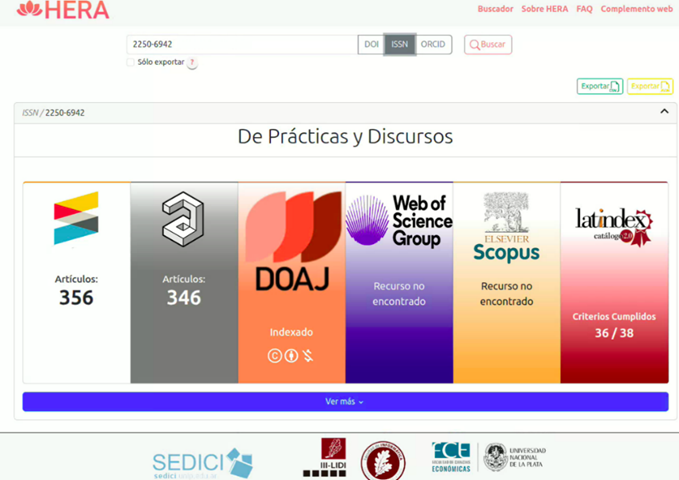
This advance strengthens immediate interoperability and facilitates more consistent access from external tools, expanding the number of users who can find these journals. New stages of joint work are planned to expand the harvest of the Latindex article discoverer.
Access the explanatory video:
https://drive.google.com/file/d/1ZEAFxW4wN2YpFYRSr9q8lHHV2sPff68Y/view?usp=drive_link
This collaboration is directly aligned with the Sustainable Development Goal (SDG) 17 (Partnerships for the Goals), which fosters revitalizing global partnerships for sustainable development through multi-stakeholder cooperation. The Latindex-HERA-CECIC alliance, based on three public universities in Latin America and supported by Horizon Europe, exemplifies cooperation that mobilizes the exchange of knowledge, technical capacity, and technology to strengthen open academic infrastructures. It also contributes to SDG 9 (Industry, Innovation and Infrastructure) through this collaborative technological solution—the URL-ISSN system—which improves scientific information infrastructure, fosters innovation in research evaluation methods, and especially supports regional production.
This collaborative work is part of a shared diagnosis among the three universities involved. A significant portion of quality journals—non-commercial, self-managed by academic communities, and aligned with diamond open access—are not adequately collected by global aggregators. In this context, facilitating access to the rich information in the Latindex 2.0 Catalog (including criteria met/not met) is strategic for information science, bibliometric studies, scientific evaluation, and public policy.