

The Opening Research Assessment to Multi-Contexts (OpenRAM) project was approved by the Horizon Europe Framework Programme (HORIZON), under the call HORIZON-MSCA-2025-SE-01. The project will run for four years, starting in September 2026 and ending in late 2030. Technological developments in open scientific infrastructure, exchanges and mobility, as well as international academic events are planned at our Faculty.
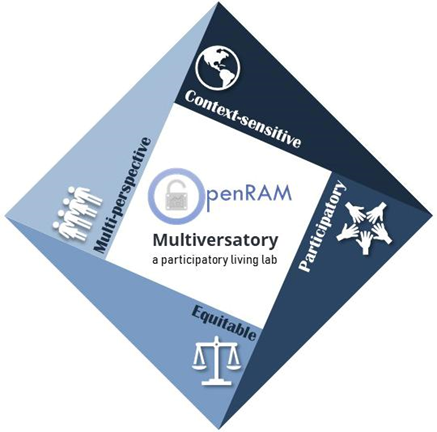
OpenRAM seeks to transform research assessment by moving beyond publication-based indicators such as Journal Impact Factor and addressing their systemic biases. Current systems often overlook societal impact, undervalue diverse outputs like datasets or policy contributions, and marginalize knowledge from underrepresented regions. To respond to these challenges, OpenRAM introduces the Multiversatory, a participatory and federated living lab that integrates diverse data sources and develops context-sensitive indicators. The Multiversatory combines conceptual development, empirical case studies, and capacity building to create fairer and more transparent assessment practices. It promotes inclusive and participatory approaches, addresses epistemic inequities by making visible diverse knowledge systems, and fosters equitable collaborations between the Global North and South. Case studies will explore career assessment, institutional evaluation, and national research systems, testing how plural and conditional metrics can be applied across different contexts. By aligning with global initiatives such as DORA, the Leiden Manifesto, CoARA, the project operationalises responsible assessment principles through open infrastructures and participatory methodologies. Its interdisciplinary consortium, spanning Europe, Latin America, and Africa, will collaborate through secondments, peer learning, and training activities, ensuring that outputs are transferable and sustainable. OpenRAM will produce federated open infrastructures, participatory frameworks, and multilingual training programmes that strengthen the visibility of diverse research contributions. Scientifically it widens what counts in evaluation, economically it reduces dependence on proprietary systems through open tools, and societally it supports more equitable recognition of research aligned with local and global challenges. In doing so, OpenRAM aims to deliver practical frameworks that make responsible research assessment a reality.
WP3 investigates data practices and research assessment through experiences (case studies, technical implementations and participatory actions) on local governance observing epistemic equity, and equal partnerships, addressing the complexities of multi-scalar interactions in research evaluation systems. The work package comprises three interconnected tasks:

By integrating these components, WP3 aims to provide actionable insights and tools to democratize research evaluation and enhance global equity in knowledge production. The outcomes will feed into broader frameworks for federated infrastructures, contributing to the project’s overarching goal of opening research assessments to multicontextual considerations.
| N. | partner | Country |
| 1 | HACETTEPE UNIVERSITESI | Turkey |
| 2 | UNIVERSITEIT LEIDEN | Netherlands |
| 3 | SIRIS ACADEMIC SL | Spain |
| 4 | THE UNIVERSITY OF EDINBURGH | United Kingdom |
| 5 | AGENCIA ESTATAL CONSEJO SUPERIOR DE INVESTIGACIONES CIENTIFICAS | Spain |
| 6 | TIETEELLISTEN SEURAIN VALTUUSKUNNASTA | Finland |
| 7 | UNIVERSIDAD DE COSTA RICA | Costa Rica |
| 8 | UNIVERSIDAD NACIONAL DE CUYO | Argentina |
| 9 | University of Campinas – UNICAMP | Brazil |
| 10 | UNIVERSIDAD DE ANTIOQUIA | Colombia |
| 11 | STELLENBOSCH UNIVERSITY | South Africa |
| 12 | CONSEJO LATINOAMERICANO DE CIENCIAS SOCIALES ASSOCIACION CIVIL | Argentina |